article
When the AI Stopped Composing for Me
How an attempt to build a symphonic suite with Suno turned into learning motifs, structure, MIDI, silence and the beginnings of orchestration.
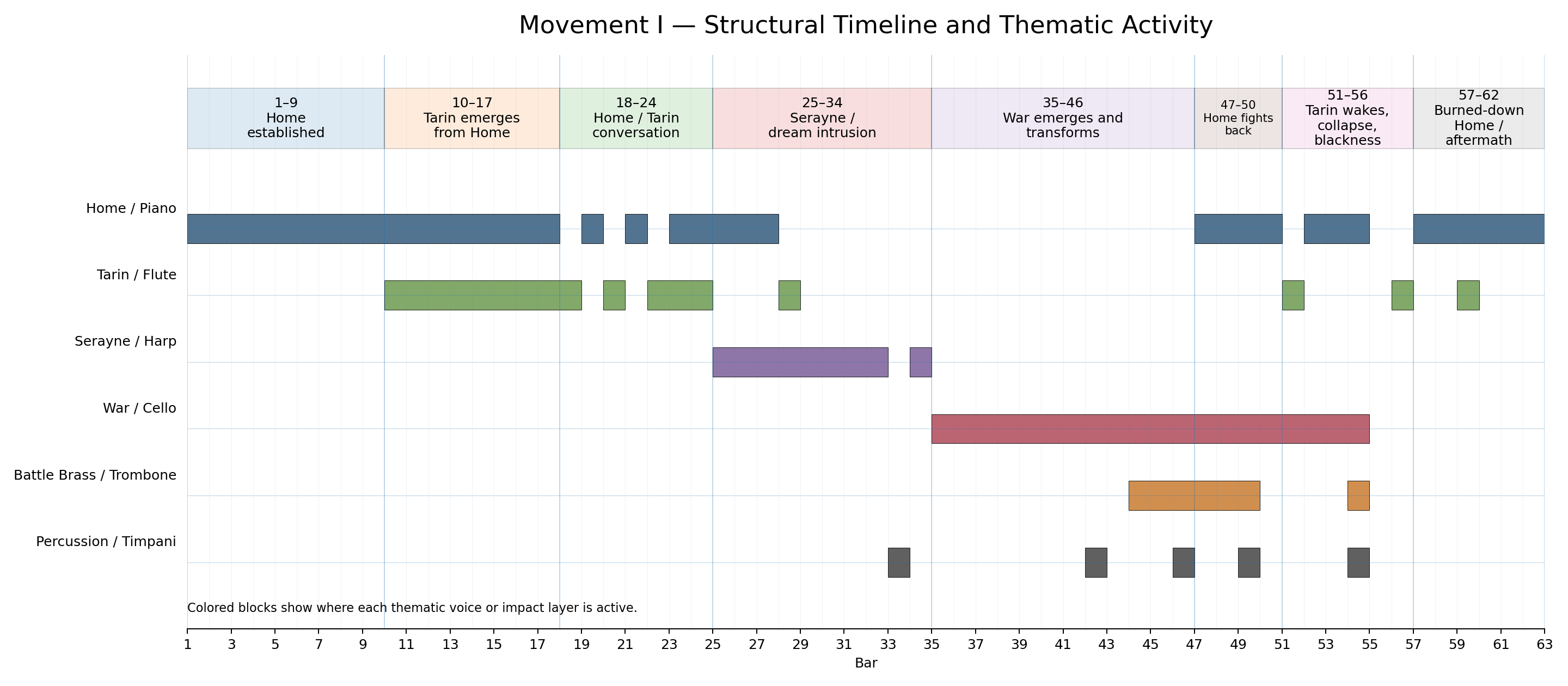
The visualization above shows the final structure of the first movement as it currently exists in MIDI form. The top band divides the movement into its dramatic sections, while the colored lanes show where each thematic voice or impact layer is active.
I started with a fairly simple idea: write a symphonic suite. Not a collection of unrelated orchestral tracks, but a connected work in which musical ideas return, change, collide and acquire meaning over time.
I already had a story in mind: a boy named Tarin, his home, a mysterious sorceress called Serayne, a knight named Aren, and a war that is much more than it first appears to be.
The initial temptation was obvious. Suno can generate impressive orchestral music remarkably quickly. Give it the right description and it can produce something dramatic, cinematic and convincing within minutes.
That was also the first problem. It could produce convincing orchestral music, but what it struggled to produce was my piece.
A theme is not yet a composition
The first step was to stop thinking in terms of prompts and start thinking in terms of musical identities.
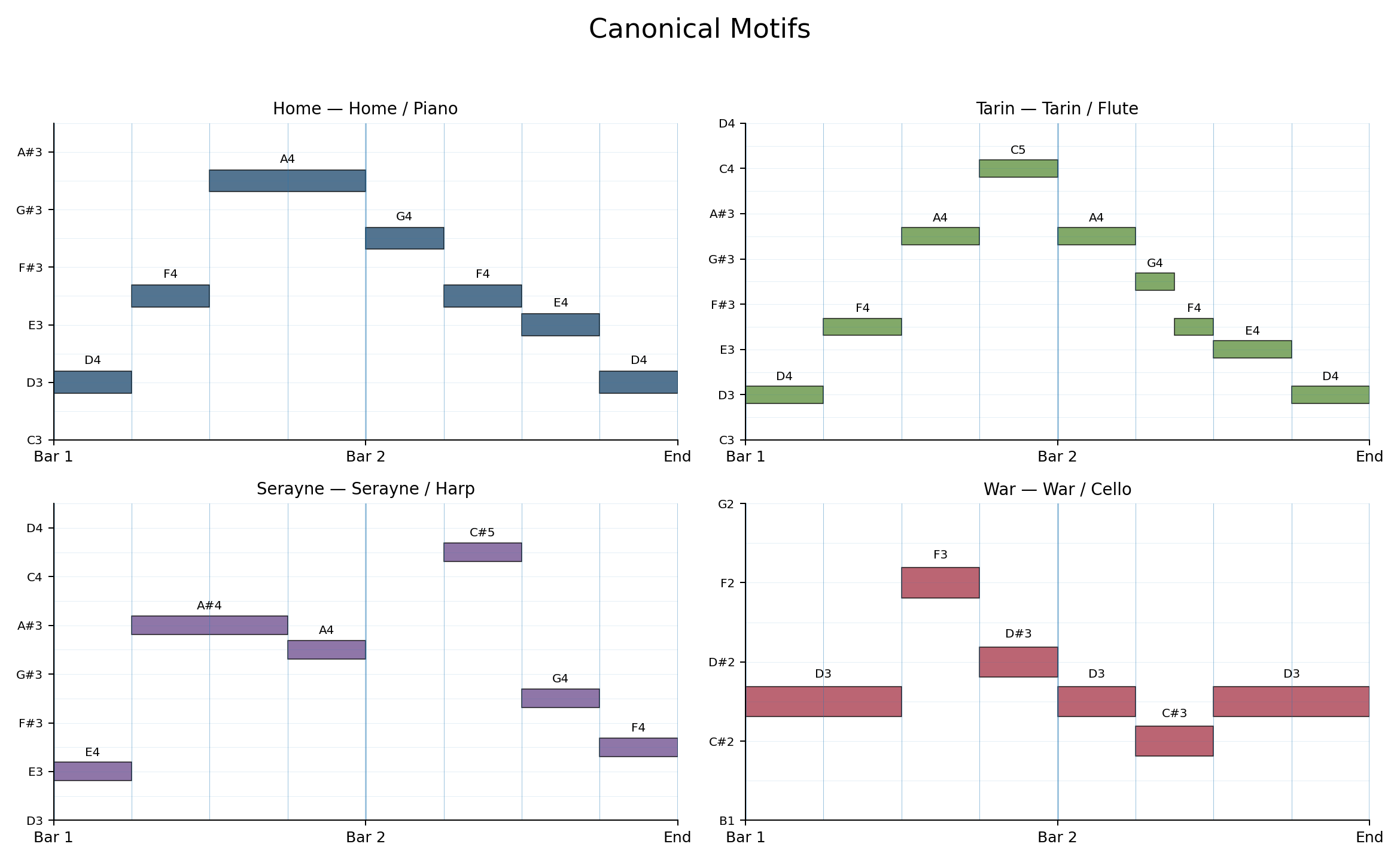
Four short motifs emerged.
Home:
D F A— | G F E DTarin:
D F A C | A G F E DSerayne:
E A#— A | rest C# G FWar:
D— F D# | D C# D—They were deliberately simple. I am not a trained composer, so this was less about showing sophistication and more about creating musical objects I could actually understand.
Home was stable and familiar. Tarin grew out of Home but reached further. Serayne introduced intervals that felt less comfortable, while War moved chromatically and heavily.
At first I tried letting Suno carry these ideas forward. It could, sort of. A generated movement might preserve the mood, instrumentation and dramatic arc while quietly replacing the actual musical material. A motif entered the model and something vaguely related came back.
That is perfectly reasonable behaviour for a generative model. It is considerably less useful when the note itself matters.
The moment the workflow changed
The turning point was embarrassingly simple: I opened an online piano roll and started placing the notes myself.
At 72 BPM, in 4/4, Home began:
Bar 1: D  F  A—
Bar 2: G  F  E  D
Then it moved. The same shape appeared around G, returned to D, and Tarin entered above it on flute. Home eventually stopped being a melody and became sustained harmony beneath him.
Suddenly I was no longer asking:
What prompt makes this sound like a symphony?
I was asking:
What should happen in the next bar?
That question changed everything.
Tarin’s theme was broken into fragments. Those fragments were transposed, shortened and allowed to overlap with Home. Serayne entered on harp while Home gradually disappeared beneath her.
I learned terms because I needed them rather than because I had decided to study theory. Fragmentation meant taking only part of a motif. Rhythmic compression meant playing the same musical idea in less time. Counterpoint meant allowing two recognisable lines to exist simultaneously.
An open fifth turned out to be nothing more mysterious than leaving the third out of a chord -D and A rather than D, F and A- yet that small omission could make Home feel less certain without making it unrecognisable.
Theory became names for things I could hear.
War had to grow out of War
The War theme caused another useful problem. Played slowly on cello, it sounded ominous, but it did not sound like battle.
The obvious solution would have been to add loud drums and brass. That worked in the superficial sense, but it felt as though battle music had simply been placed on top of the composition.
Instead, War itself had to transform.
The two-bar theme was compressed into one. Then fragments were removed, the surviving pitches became repeated eighth notes, and the pattern was rotated so its starting point became unstable. Only then did timpani appear, followed by trombones.
The brass did not introduce unrelated chords. It took adjacent pitches already present in War and played them simultaneously, turning melodic tension into harmonic collision.
By the time the orchestra began to feel violent, almost everything could still be traced back to the original six notes. That was an unexpectedly important lesson: development was more convincing than addition.
Destroying Home
The battle became musically interesting only when Home returned.
The piano stated its theme again while the War machinery continued underneath it. For two bars, Home remained recognisable. Then it tried to begin again:
D F A...and was interrupted.
The following bar contained only fragments:
G ... F ... E ... DHome had not merely become quieter. Its structure had been damaged, and that distinction mattered.
The story required Tarin to wake during the attack, call for his mother and father, experience the collapse of the house, lose consciousness and wake again among the ruins. Mother and Father did not receive new themes. Instead, each was represented by part of Home.
One carried its beginning. The other completed its descent. Together they almost reconstructed the original theme just before the roof collapsed.
Then there was silence. Not a quiet pad or a cinematic tail. An empty bar. Silence had become part of the score.
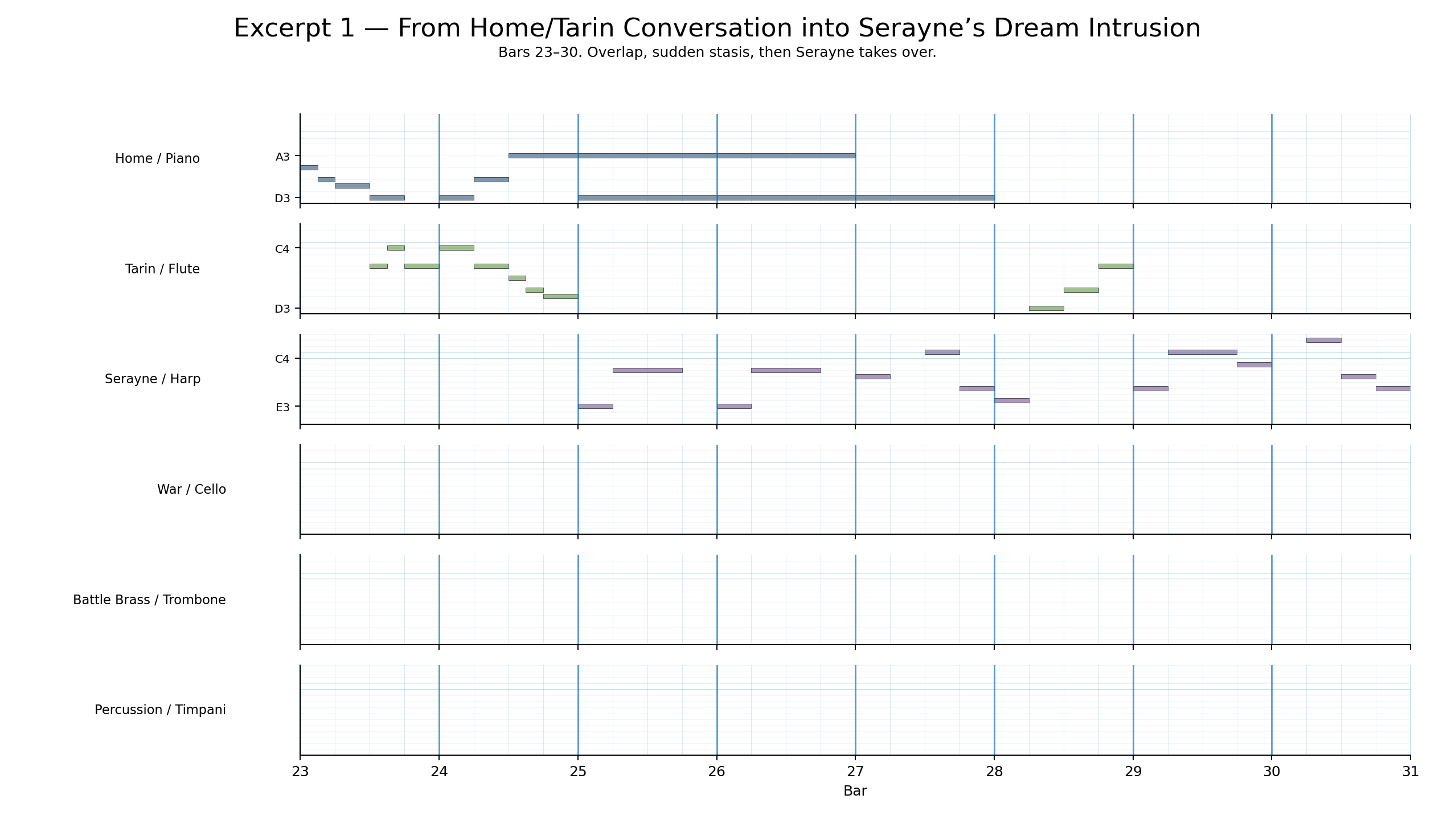
One of the most satisfying discoveries was that these dramatic turns become much easier to reason about when seen as note events. In the excerpt above, the shift from Tarin/Home interplay into Serayne’s dream intrusion is visible at a glance: overlap, sudden stasis, then takeover.
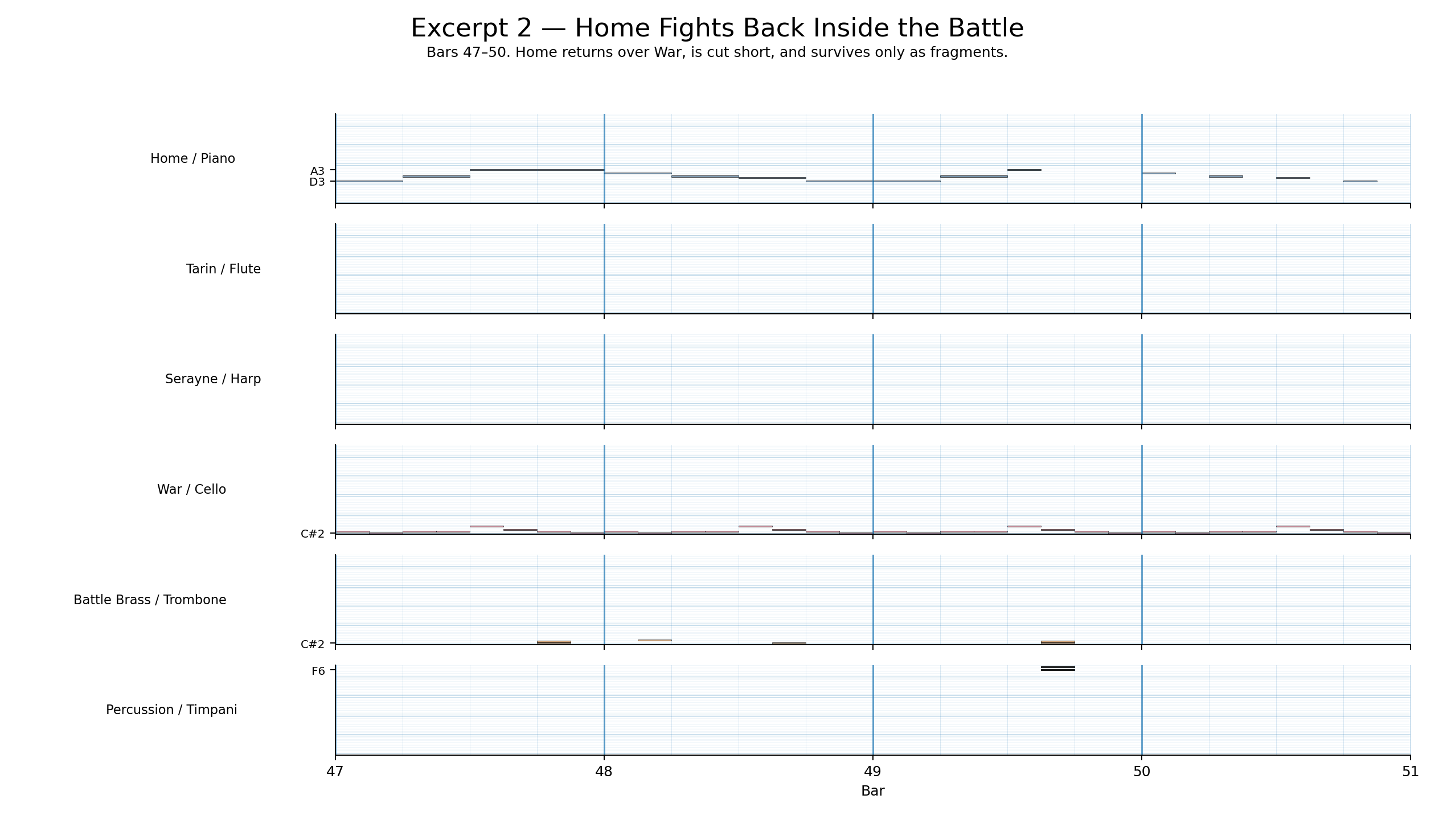
The same is true later in the movement. Home’s return inside the battle only really works because it remains clearly audible before it is cut short and reduced to fragments.
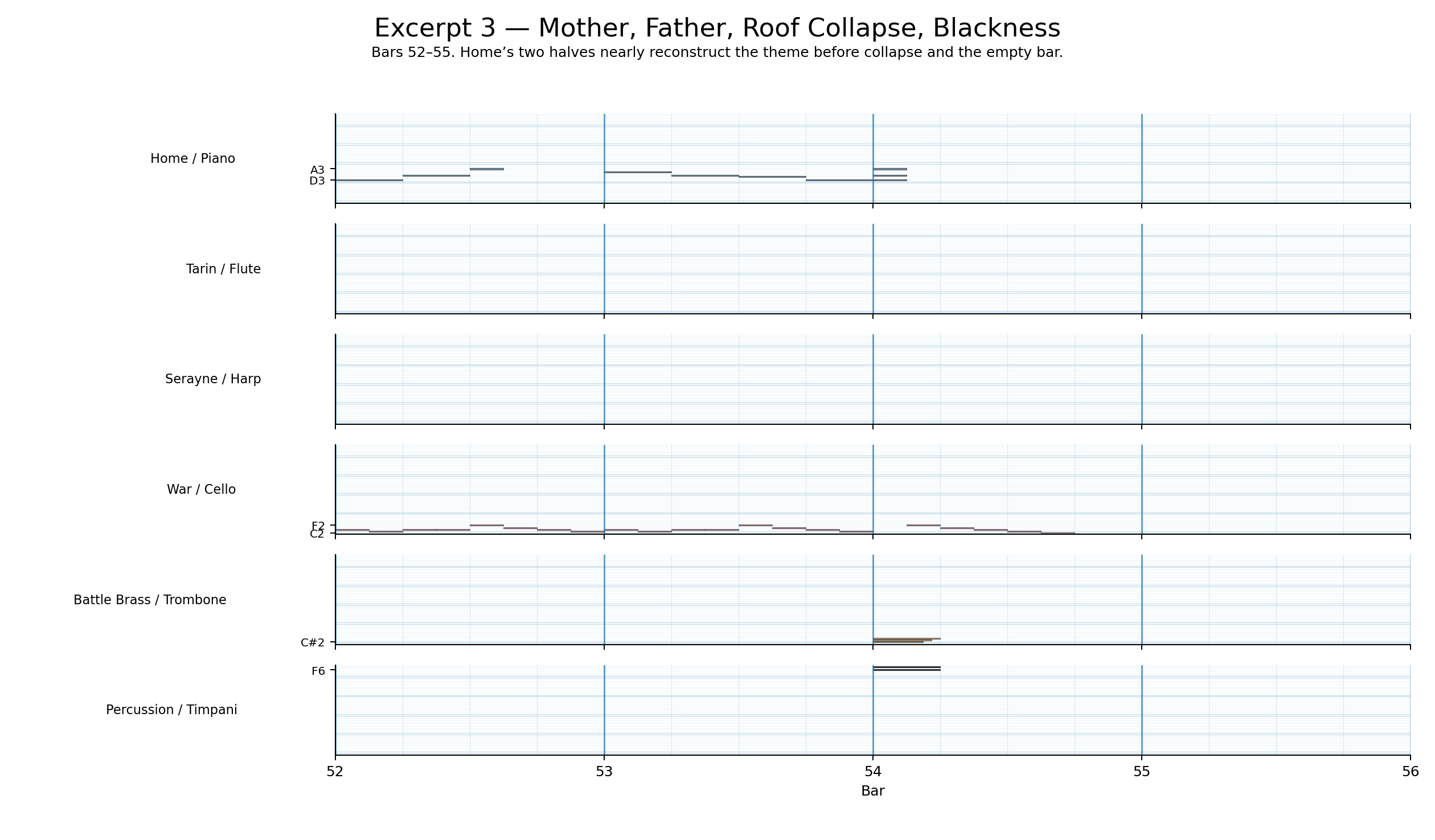
The collapse itself crushed Home into a chord, War into a cluster, and then left a genuinely empty bar. That empty bar matters as much as many of the notes around it.
And that is where the AI failed again
Once the movement was complete, I returned to Suno Studio. This time I was no longer asking it to compose anything.
I gave it the MIDI and asked for something apparently much simpler: play these notes on a grand piano. Keep the notes, their durations, their velocities and, especially, the rests.
It did not.
Where the MIDI contained silence, the generated performance often continued playing. Suno treated empty space as an opportunity to improvise.
That revealed the fundamental mismatch. I was now working with a score; Suno was still working with suggestions. No prompt could completely reconcile those two things.
The MIDI said:
Nothing happens here.
The model heard:
Something could happen here.
For generative music, that instinct is useful. For composition, sometimes nothing happening is precisely the point.
The next movement
By this point, something had changed. I had started with four tiny motifs and an AI music generator. I now had a complete MIDI sequence: more than sixty bars in which those motifs appear, disappear, overlap, accelerate, fracture and eventually collapse.
It was still skeletal. A piano was Home. A flute was Tarin. A harp was Serayne. A cello was War. Trombone and timpani supplied some of the violence around them.
But those instruments were mostly carrying individual lines. This was not yet an orchestral score, and that created the next problem.
How do you turn this:
Cello:  D —————————
Viola:  A —————————
Piano:  D  F  A— | G  F  E  D
into something that actually feels like an orchestra?
The first answer was wonderfully small. The cello does not need another melody; it can simply hold D. The viola can hold A. Together they form an open fifth beneath Home.
Nothing spectacular happens. No new theme appears. The music simply acquires depth.
That may sound elementary to anyone who has studied orchestration, but to me it was another shift in how I was thinking. Until then, adding an instrument had mostly meant giving it something to play.
Now I was beginning to understand that orchestration is also about function. One instrument can carry identity. Another can supply weight. Another can change the colour of a harmony without contributing any new musical information at all.
And that is where the project currently stands. The MIDI sequence exists. The themes and their transformations exist. The dramatic structure of the first movement exists.
What does not yet exist is the orchestra.
The tooling question returns
That also means the tooling problem is not solved.
A simple browser piano roll was surprisingly good for composing the underlying material because it got almost everything else out of the way. Notes, durations, instruments and bars were visible immediately.
Orchestration asks for more: articulations, dynamics, expression, better instrumental sounds, multiple string sections, brass voicings, balance, possibly automation and, eventually, perhaps notation.
I do not yet know which combination of tools will make the most sense. More importantly, I do not yet know exactly what I need to learn.
That is probably the interesting part.
The next stage is no longer:
How do I get an AI to orchestrate this?
It is:
What does this music actually need from an orchestra?
That question leads somewhere very different. It means learning why a cello and viola might hold an open fifth beneath a melody, why a horn should enter here but not there, why doubling a line can strengthen it in one passage and destroy its character in another, and why register, articulation and dynamics may matter as much as the notes themselves.
The first movement has therefore reached an odd intermediate state.
It is composed, but not finished. And for once, that distinction feels useful.
The tool changed roles
AI is still part of the project. It helped me explore structures, test ideas, understand terminology and hear possibilities I would probably not have reached as quickly on my own.
But its role changed.
At the beginning I wanted the machine to generate the music. Now I want it to help me understand what I am doing while I make decisions myself.
That difference is much larger than it sounds.
The interesting question is no longer whether an AI can produce something that sounds orchestral. It clearly can.
The interesting question is whether I can learn enough to understand why this particular piece should sound the way it does.
For now, that begins with something very small: a cello holding D, a viola holding A, and listening to what happens.